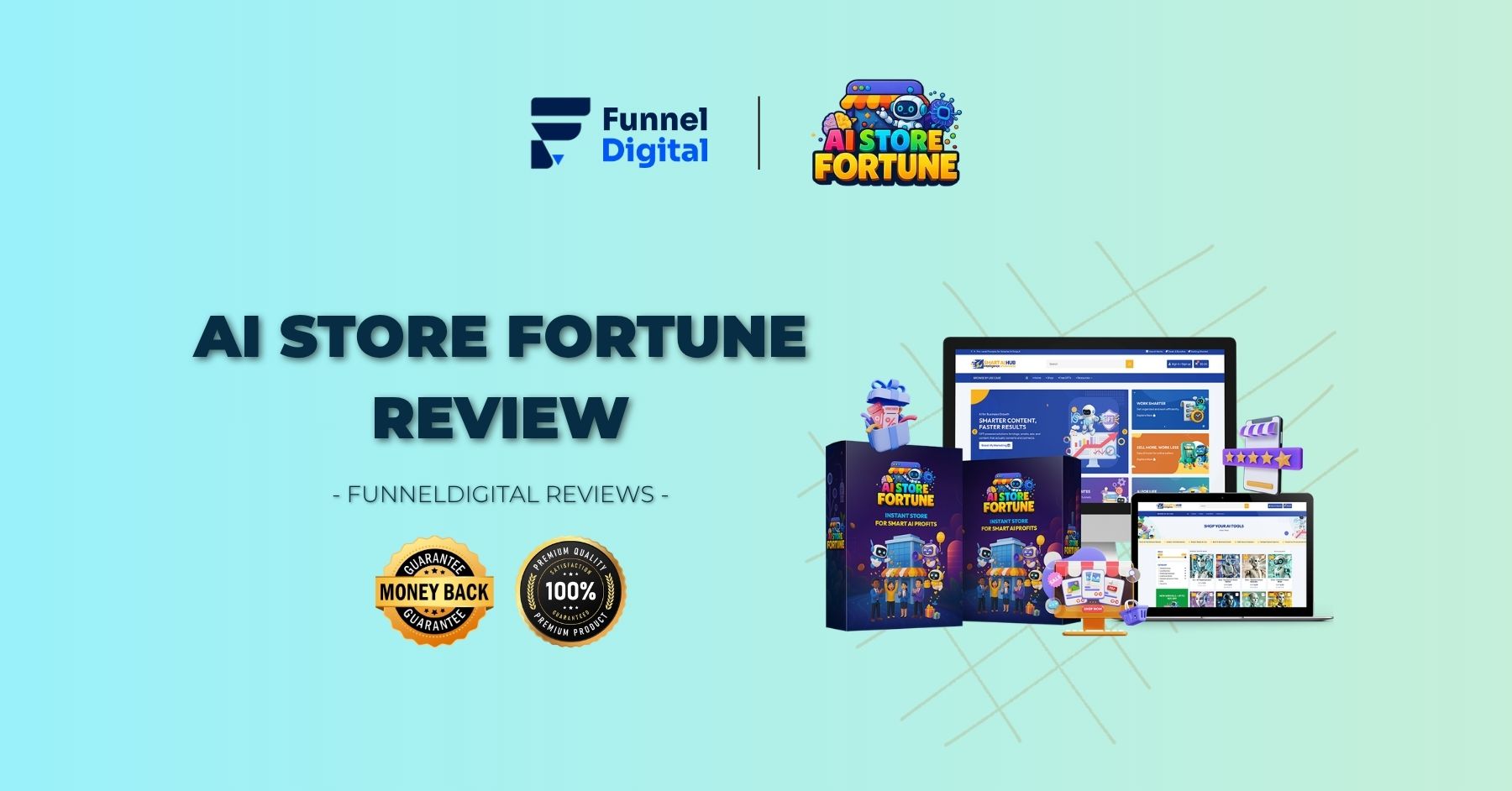
AI Store Fortune review: a done-for-you WordPress store loaded with GPTs and AI prompts. Read our honest breakdown before you buy.
If you’ve been searching for a faster way into the AI reselling niche, this AI Store Fortune review breaks down exactly what’s inside the package, who it actually fits, and where the rough edges are — so you can decide with your eyes open instead of just trusting the sales page.
Selling AI products sounds simple until you actually try to build the store yourself. You need a platform, a payment system, product pages, descriptions, images, download links, and somehow a steady stream of products to sell. That’s a lot of moving parts for something that’s supposed to be a “side hustle.”
AI Store Fortune promises to remove almost all of that friction by handing you a pre-built WordPress store stocked with GPT bundles and AI prompt packs, ready to switch on in minutes. In this AI Store Fortune review, I’ll walk through what’s actually included, how the setup process works in practice, who this product genuinely suits, and the parts of the offer that deserve a more skeptical look before you reach for your wallet.
AI Store Fortune review: what exactly are you buying?
At its core, AI Store Fortune is a WordPress and WooCommerce template package. You get a backup file of a fully built ecommerce site, themed around selling GPTs and AI prompt bundles, plus a catalog of pre-loaded digital products that are supposedly ready to sell the moment you import the backup.
It’s built on the Divi theme with WooCommerce handling the storefront mechanics — cart, checkout, product pages, and the customer account dashboard. Instead of starting from a blank WordPress install and building category structures, page layouts, and product listings from scratch, you import a single backup file and the entire site structure appears.
The pitch is straightforward: skip the technical setup, skip the content writing, skip the design work, and launch a store that already looks like it belongs to an established AI brand.
What’s inside the package
Based on the sales materials, here’s what ships with the core offer:
- A WordPress backup file containing the full demo site (homepage, shop page, product pages, category pages, blog, support page)
- A catalog of GPT prompt bundles and AI prompt packs, pre-imported with images, descriptions, and download links attached
- Live AJAX search and filtering on the shop page
- A customer account system so buyers can log in and revisit their purchase history
- Pre-written website copy across all core pages
- A blog pre-loaded with articles, intended to help with SEO
- Legal pages (privacy policy, refund policy, etc.) already drafted
- A promotional video template (built in Canva) and a set of social media graphic templates
- Step-by-step installation training and an unlimited personal-use license to build multiple stores
There’s also an upsell — a “GPT Product Creation Suite” — sold as a bump offer for generating new GPT ideas and product listings down the line.
AI Store Fortune review: how the setup actually works
One of the strongest selling points in any AI Store Fortune review you’ll come across is the claimed simplicity of installation. According to the vendor, the process breaks down into three steps:
Step 1: Import the WordPress backup
You install WordPress on your own hosting, then restore the provided backup file. This is the part that does the heavy lifting — instead of manually building pages, installing WooCommerce, configuring product categories, and writing copy, the entire site structure, theme settings, and product catalog arrive in one file.
If you’ve ever restored a WordPress backup before, you know this part is genuinely fast when it works cleanly. The caveat: backup-based installs can be finicky depending on your hosting environment, PHP version, and existing plugins. If you’re running this on a fresh subdomain or fresh hosting account (similar to how many WordPress-based affiliate or ecommerce sites get spun up), the import tends to go more smoothly than trying to layer it onto an existing, plugin-heavy WordPress install.
Step 2: Connect a payment gateway
Once the site is live, you connect PayPal, Stripe, or another supported gateway through WooCommerce’s native payment settings. This is standard WooCommerce configuration — nothing proprietary to this product — so if you’ve set up payments on any WooCommerce store before, this step is familiar territory.
Step 3: Promote the store
This is where the included marketing assets come in: the DFY promo video template and the social media graphic templates. The vendor frames this as the easy part, but realistically, traffic generation is the step most buyers underestimate. A store with zero visitors doesn’t make sales regardless of how polished the design is.
AI Store Fortune review: who this product actually fits
Not every done-for-you product fits every buyer, and an honest AI Store Fortune review needs to say that plainly. This package is built around three deliverables: a pre-built website, pre-loaded products, and pre-written promotional materials. Whether that combination is valuable to you depends heavily on where you are right now.
Good fit if:
- You already have an audience (email list, social following, or community) interested in AI tools, productivity, or marketing resources, and you just need a storefront to monetize that audience
- You want to test the AI prompt-reselling niche without committing weeks to building infrastructure first
- You’re comfortable with WordPress basics (or willing to follow a guided import process) but don’t want to design pages or write product copy from scratch
- You’re looking for a personal-use template to launch multiple niche stores under your unlimited license
Probably not a good fit if:
- You expect a “passive income” outcome with no ongoing work — the vendor’s own disclaimer is explicit that this isn’t a passive system and requires consistent promotion
- You have zero existing audience and no traffic plan; a polished store without visitors still won’t generate revenue
- You’re hoping to build a unique, differentiated brand — since this is a template product, other buyers will be running visually similar (sometimes identical) stores
- You want full creative control over original GPT development rather than reselling templated prompt packs
AI Store Fortune review: examining the product catalog claims
This is probably the most important section of this AI Store Fortune review, because it’s where buyers most often get a surprise after purchase.
The sales page advertises “hundreds of GPTs” and “tens of thousands of AI prompts.” It’s worth pausing on what that actually means in practice. These are not custom-trained AI models — they’re PLR-style (private label rights) prompt packs and prompt templates, bundled into digital products you can resell. That’s a completely legitimate digital product category, and reselling prompt packs is a real, established niche. But it’s a different thing than building or owning actual GPT models, and the wording on sales pages in this space can blur that line more than it should.
If you’re evaluating this for your own use, it’s worth asking the vendor (before or after purchase, depending on their support policy) a few practical questions:
- Are the prompts unique to this package, or are they recycled from other widely distributed PLR bundles already saturating the market?
- What license do you actually hold on the bundled content — can you resell it as-is, rebrand it, or only distribute it under specific terms?
- How current are the prompts? AI tooling and prompt engineering best practices move fast, and a prompt pack compiled even a year ago may reference outdated model behavior.
None of this means the product is dishonest — PLR AI content is a normal, functioning business model, and thousands of digital sellers operate this way. But “ready-to-sell” doesn’t mean “exclusive” or “evergreen,” and that distinction matters for anyone planning long-term revenue rather than a one-time launch bump.
AI Store Fortune review: design, UX and store features
On pure user-experience grounds, the feature set described is reasonably solid for a template ecommerce package. Live AJAX search and category filtering genuinely improve the shopping experience compared to a default WooCommerce shop page, especially once a catalog grows past a hundred products. A customer account dashboard that lets buyers see purchase history and re-download files is also a feature many beginner stores skip — and it noticeably reduces support tickets like “I lost my download link.”
The Divi theme foundation means you retain visual editing control after import. If you know your way around Divi’s builder, you can restyle sections, swap colors, adjust typography, and customize layouts without touching code. That flexibility is useful if you don’t want your store to look identical to every other buyer’s site.
Where I’d recommend caution: a “beautiful, clean, professional” design claim is subjective, and templated designs — by definition — won’t differentiate you from competitors using the same package. If your strategy depends on brand distinctiveness (which matters a lot for trust-based purchases like AI tools), plan to invest at least some time in customizing colors, copy tone, logo, and homepage messaging so your store doesn’t read as a carbon copy of someone else’s.
AI Store Fortune review: pricing, guarantee, and the upsell structure
At the time of writing, the front-end offer is priced at $27 (discounted from a stated $97 list price, with an additional $20 off code mentioned on the page). The vendor backs the purchase with a 30-day money-back guarantee, framed around resolving technical issues rather than a no-questions-asked refund — worth reading the actual refund policy page rather than assuming blanket coverage.
There’s also a bump offer — the “GPT Product Creation Suite” — priced separately (around $16.95 in the discounted bundle), which is positioned to help you generate new GPT-style product ideas and listings after you’ve launched. This is a common structure in the WarriorPlus/JVZoo-style launch ecosystem: a low-cost front-end offer designed to get you in the door, followed by one or more upsells (OTOs) that aren’t detailed on the main sales page itself.
Two practical notes for buyers:
- WarriorPlus handles payment processing, not support. Per the vendor’s own disclaimer, all product support, refund requests, and questions go directly to the seller — not the marketplace. If you buy, confirm you understand the seller’s actual response time before relying on “1-year email support” as your only backup plan.
- Read the OTO structure before checkout. Launch-style funnels typically present additional offers during the checkout flow. Decide your budget ceiling before you start clicking through, so you’re not making upsell decisions on the fly.
AI Store Fortune review: comparing the cost math
The sales page makes a cost-comparison argument: building an equivalent store manually (ecommerce platform fees, individually priced prompt products, a hired designer/developer) could run anywhere from a few hundred to a few thousand dollars. That comparison is directionally reasonable — Shopify-style subscription costs plus app fees plus freelance design work absolutely can add up to that range over time.
But it’s worth applying a more grounded lens here too. A self-hosted WordPress and WooCommerce store with a single premium theme can often be built for well under $100 in software costs if you’re willing to write your own copy and source products incrementally rather than buying a pre-loaded catalog on day one. The real value proposition of a done-for-you package isn’t that the alternative is impossible — it’s that it compresses weeks of setup time into a single afternoon. Whether that time-compression is worth $27 to you is a fairly easy “yes” for most people; whether the long-term catalog and design choices suit your specific niche is the harder question, and one only you can answer based on your audience and goals.
AI Store Fortune review: strengths worth highlighting
To keep this AI Store Fortune review balanced, here’s where the package genuinely delivers value:
- Genuinely low barrier to entry. If your alternative is “I’ll get around to building a store eventually,” this removes the procrastination point entirely.
- No recurring platform fees. Unlike Shopify or similar hosted platforms, you’re not paying a monthly subscription just to keep the store online — only your standard hosting and domain costs apply.
- Unlimited personal-use license. Being able to spin up multiple niche stores from one purchase is a meaningful multiplier if you’re testing several angles (for example, one store targeting marketers, another targeting local businesses).
- Reasonable feature parity with paid SaaS alternatives. AJAX search, filtering, and a customer dashboard are features some no-code store builders charge extra for.
- Low financial risk at the front-end price point. At $27, the downside of trying it is small relative to the potential time saved.
AI Store Fortune review: limitations to weigh seriously
An honest review also needs to flag the friction points:
- Saturation risk. Any product sold to a wide buyer base on a launch-jacking-style marketplace will, by definition, be running on multiple competing stores. Differentiation work falls on you.
- “Ready-to-sell” isn’t “ready-to-rank” or “ready-to-convert.” A pre-built site gets you live faster; it doesn’t replace SEO work, traffic generation, or ongoing content updates.
- Product freshness is unverifiable from the sales page alone. Ask before buying how often the prompt catalog gets refreshed, if at all.
- Support routes through the seller, not the marketplace. Manage expectations around response times accordingly.
- The earnings disclaimer is explicit: this is not a passive income system, and the vendor states plainly that results depend entirely on the buyer’s effort and traffic strategy.
AI Store Fortune review: practical tips if you decide to buy
If, after reading this far, you’re leaning toward picking this up, a few suggestions based on common pitfalls with template-based store launches:
- Customize before you promote. Spend an hour or two adjusting colors, the homepage headline, and your “About” page copy so the store doesn’t read as an obvious clone.
- Audit the product catalog for license clarity. Before reselling anything, confirm exactly what rights transfer to you and, in turn, to your customers.
- Treat the included marketing assets as a starting point, not a complete strategy. A promo video template and social graphics help with consistency, but you’ll still need an actual traffic plan — content, paid ads, or community engagement — to drive buyers to the store.
- Set a realistic timeline. Don’t expect meaningful revenue in week one. Like any ecommerce launch, traction typically builds over weeks or months of consistent promotion.
- Keep your refund window in mind. Test the full purchase-to-download flow as a customer would within the guarantee period, so you can request a refund quickly if something doesn’t match expectations.
AI Store Fortune review: SEO and organic traffic potential
A question that comes up often around any done-for-you store package is whether the included blog and pre-written copy actually help with search visibility, or whether they just look like content without doing any real SEO work. It’s a fair question, and worth unpacking here.
A pre-loaded blog with several articles can give you a head start in the sense that you’re not staring at an empty content calendar on day one. But pre-written, templated blog posts shared across many buyers of the same package carry an obvious limitation: if dozens of stores publish near-identical articles, search engines have little reason to rank any single one of them highly. Duplicate or near-duplicate content across multiple domains tends to get filtered out of search results rather than rewarded.
If organic traffic is part of your plan, treat the included blog as a content skeleton rather than a finished SEO asset. Practical steps that make a meaningful difference:
- Rewrite the pre-loaded articles in your own voice, with original examples and updated information, rather than publishing them verbatim
- Add genuinely useful, specific content — comparisons between AI tools, use-case walkthroughs, or niche-specific guides for the audience you’re targeting (marketers, local business owners, content creators, etc.)
- Build out category and product pages with unique descriptions instead of relying solely on the bundled copy, since duplicate product descriptions across many similar stores create the same ranking problem as duplicate blog posts
- Set up basic technical SEO correctly from the start — clean permalinks, proper meta titles and descriptions, and a logical category structure — since these fundamentals matter regardless of which theme or template powers the site
None of this is unique to AI Store Fortune; it’s a general truth about any templated or PLR-based content strategy. The store itself can be live in minutes, but ranking it organically still takes the same sustained content effort any new site requires.
AI Store Fortune review: realistic revenue expectations
It’s worth being direct about something the sales page itself acknowledges in its disclaimer: this is not a passive income system, and there’s no guarantee of any specific outcome. That’s standard, necessary legal language for this product category, but it’s also simply true of digital product reselling in general.
A more useful way to think about potential outcomes is to separate the three variables that actually determine whether a store like this makes money:
- Traffic. Without visitors, a perfectly designed store with zero traffic produces zero sales. This is true of every ecommerce business, template-based or custom-built.
- Offer-market fit. AI prompt packs and GPT bundles are popular right now, but the buyer pool for generic prompt packs is different from the buyer pool for a specific, well-positioned niche offer (for example, prompts tailored specifically to real estate agents, or to e-commerce copywriters). The more generic the catalog stays, the harder it competes against free resources already available online.
- Trust signals. Because this niche has a reputation for oversaturated, low-effort resale stores, buyers increasingly look for signs of a real business — clear policies, responsive support, visible testimonials, and a brand that doesn’t look identical to ten other sites they’ve seen. Investing time into these trust signals tends to matter more for conversion than any single design feature.
If you go in expecting a tool that removes the technical barrier to starting (which it appears to do reasonably well) rather than a tool that removes the business barrier to making sales (which no software package can do), your expectations will likely match reality much more closely.
AI Store Fortune review: frequently asked questions
Does AI Store Fortune require coding skills? No coding is required for the core setup. Importing the WordPress backup and connecting a payment gateway through WooCommerce are both point-and-click processes. Customizing the Divi-based design further is optional and uses a visual builder rather than code, though some comfort navigating WordPress admin will make the process smoother.
Can I add my own products alongside the included catalog? Yes. Since the store runs on standard WooCommerce, adding new products follows the normal WooCommerce product-creation flow — set a title, price, description, and upload your file. This also means you’re not limited to the bundled catalog long-term; you can diversify with your own PLR purchases, your own prompt creations, or other digital products entirely.
Do I need my own hosting and domain? Yes. The package provides the site structure and content, but you still need your own WordPress hosting account and domain name to install it on. Budget for these as ongoing costs separate from the one-time product price.
Is the included catalog exclusive to buyers of this package? This is the single most important question to clarify directly with the vendor before purchase, since the answer materially affects how much differentiation you’ll have against other buyers running the same package. Sales pages in this category rarely spell out exclusivity terms in detail, so it’s worth asking support directly.
What happens after the 30-day guarantee window? Refund eligibility is generally tied to the guarantee period stated by the vendor, so it’s worth testing the full setup and product-download flow as soon as possible after purchase rather than letting the window lapse before evaluating the package properly.
Final verdict on this AI Store Fortune review
AI Store Fortune solves a real problem — the tedious, time-consuming setup phase of launching a digital product store — reasonably well for the price point. If your goal is to get a functional AI-niche storefront online quickly without learning WooCommerce from scratch or hiring a designer, it does what it says on that front.
Where you need to manage your own expectations is everything after installation. A pre-loaded catalog and a polished theme don’t replace differentiation, ongoing product curation, or a genuine traffic strategy. Buyers who treat this as a fast foundation to build on — rather than a finished, hands-off business — are the ones most likely to see it pay off.
If you already have an audience or a clear promotion plan and you’re comfortable with the PLR-style nature of the bundled prompts, the low front-end price makes this a reasonably low-risk way to test the AI reselling niche. If you’re hoping for a passive, hands-free income stream, this — like virtually every DFY product in this category — isn’t that, and the vendor says as much in their own disclaimer.
Read more: AdCreative AI Review